

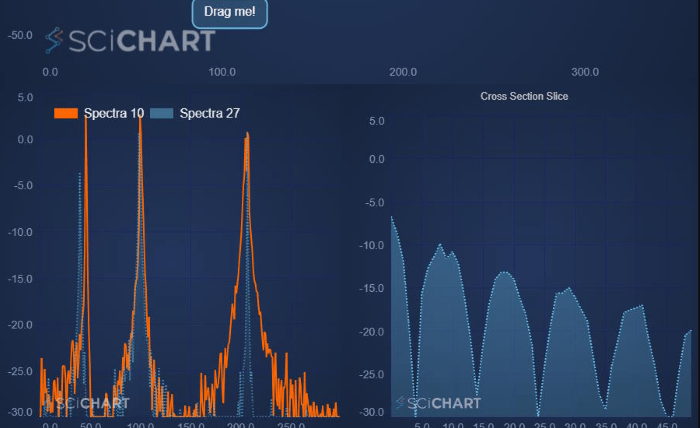
Mounting evidence suggests that dark matter accounts for much of the universe’s total mass, yet it remains notoriously difficult to detect. With newly emerging methods of visualising astronomical data, insights that once seemed elusive are now coming into sharper focus. By harnessing modern techniques and leveraging ever-more powerful computational resources, scientists can examine cosmic data sets in unprecedented detail. This progress is not solely due to novel observational equipment; it is also a result of sophisticated platforms designed to process and display complex information. One such domain is that of JavaScript Charts, a flexible and dynamic means of creating interactive visual narratives that communicate intricate discoveries.
One developer from SciChart shares professional advice for those seeking to handle large-scale astrophysical data: “In projects where the volume and complexity of information can be overwhelming, a robust JavaScript chart library frequently proves invaluable. Not only can it handle the computational load, but it also offers extensive capabilities for rendering multiple dimensions of astronomical data in real time.” According to this developer, the capability to merge performance and clarity in a single environment can dramatically enhance the way scientists interpret cosmic data. Visual tools that accommodate massive data inputs are indispensable, helping explorers of the cosmos unpick the layers that conceal the secrets of dark matter. By coupling cutting-edge analytical processes with intuitive design and seamless web integration, researchers are empowered to communicate their findings to both the scientific community and the public.
Introduction to Dark Matter Observations
Advancements in observational technology over the past few decades have yielded vast improvements in the volume and quality of cosmic information. Telescopes positioned around the planet, along with space-based observatories, have provided astronomers with a torrent of data on phenomena such as gravitational lensing, galactic rotation curves, and cosmic microwave background fluctuations. These strands of evidence converge on a single, unresolved enigma: the presence of an unknown substance shaping the large-scale structure of the universe.
Dark matter itself neither emits nor reflects light, making it practically invisible to direct observation. Instead, researchers rely on its gravitational effects to measure its existence. Galaxies rotate at speeds that cannot be accounted for by visible matter alone, clusters of galaxies bend light more powerfully than predicted, and radiation left over from the early universe contains anomalies best explained by a hidden mass component. Despite these clues, no definitive detection of the dark matter particle has been announced. Instead, scientists carry on layering new data sets, employing deeper and more specialised probes to test existing theories.
Traditional approaches to data analysis can become unwieldy as the scale and granularity of information expand. Manually sifting through reams of raw inputs risks overlooking subtle correlations. Consequently, the field has seen a shift towards more sophisticated computational methods, leaning into advanced data analytics and real-time visualisation as central tools for interpreting cosmic phenomena. Whether examining gravitational lensing arcs that highlight pockets of dark matter or dissecting the velocity profiles of far-off galaxies, the capacity to interpret complex patterns visually has helped accelerate progress.
The Role of Next-Gen Visualisation in Modern Astronomy
Cosmology and astrophysics do not operate in a vacuum. They are guided and enriched by technological innovation. Historically, breakthroughs such as radio astronomy and X-ray observatories changed the landscape of cosmic research, offering glimpses of the universe through new wavelengths. The next frontier has evolved from a purely observational revolution to a computational one. Tools for data management, algorithms for statistical inference, and advanced visualisation frameworks have become the backbone of modern research.
As new findings continue to mount, researchers must handle data on an unprecedented scale. Surveys are capturing swathes of the sky that were simply unattainable decades ago, measuring stars by the millions and galaxies by the billions. Streaming results from orbiting telescopes, ground-based arrays, and dedicated cosmic-ray detectors amplify the call for adaptive methods that can digest and interpret these torrents of data.
Next-generation visualisation solutions step into this scenario by providing interactive, web-based frameworks that offer on-demand manipulation of data sets. This is particularly pertinent for collaborative work, as astronomers scattered across continents can share the same interactive plots or real-time dashboards. With such setups, they can isolate anomalies, highlight possible correlations, and model predictions across thousands of parameters. Ultimately, these interactive displays can present a fresh perspective: instead of tackling pages of numbers, experts can visualise cosmic structures, linking distributions or intensities to direct physical interpretations.
Dark Matter’s Elusive Nature and the Emerging Data Techniques
When it comes to charting the unknown, astronomers rely on indirect observational markers. Because dark matter does not interact electromagnetically, it reveals itself only through gravitational pull or potential collisions with normal matter in specific conditions. Space-time curvature, gravitational lensing arcs, cluster velocity dispersions, and cosmic background radiation patterns are among the best clues. Because so many variables affect these measurements, analysing them without automated and visual approaches would be excruciatingly complex.
New data techniques allow researchers to layer multiple sources of information, from X-ray or gamma-ray signals to radial velocity data captured via spectroscopy. By superimposing these signals in a dynamic interface, scientists might identify patterns indicative of dark matter concentrations. The synergy of big data analytics and real-time visualisation can underscore subtle relationships between distinct phenomena, hinting at the mass distribution in galactic halos or unveiling unexpected anomalies in gravitational wave signals.
Where older static plots might have once been sufficient, the constantly evolving nature of cosmic research demands more agile solutions. The necessity for iterative refinement means that results often require rapid recalculation as new data arrives. Next-gen visualisation tools integrate these iterative processes, updating visual outputs on the fly. Hence, theories can be tested in near real time, fueling a cycle of immediate feedback and continuous improvement.
Challenges in Representing Astronomical Complexity
Though advanced frameworks exist to help parse cosmic information, depicting the complexity of the universe is still challenging. Astronomical data covers enormous scales, from subatomic processes that might reveal a dark matter candidate particle to cosmic-scale observations of galaxy clusters and superclusters. Each domain has its nuances, requiring different representation styles.
Even with high-powered rendering, it can be difficult to convey the full scope of cosmic phenomena without overwhelming the viewer. A single galaxy cluster may hold trillions of stars, and that cluster is but a fragment of the observable universe. Dark matter, believed to be far more prevalent than the baryonic matter forming stars and planets, permeates these structures in enormous filaments spanning millions of light-years.
Visual tools that rely solely on traditional methods may struggle to account for the interplay of multiple dimensions or time-varying data. High-dimensional data sets that track the evolution of certain cosmic parameters across billions of years need robust computational frameworks that can handle not just breadth but depth. Conventional graphing approaches risk losing or distorting crucial subtleties. Hence, real-time rendering solutions that incorporate zooming, panning, layered charts, and parametric filtering can be game-changers, allowing experts to home in on specific aspects before broadening out again for an overview of how these details interact within the grander cosmic structure.
How JavaScript Charts Aid Astronomical Research
At the intersection of these cutting-edge scientific demands and rapidly evolving computing platforms, JavaScript Charts are emerging as a versatile and pragmatic solution for researchers who require both accessibility and performance. Through interactive, web-based charts, astronomers can load, manipulate, and examine large data sets without resorting to overly complex interfaces. The convenience of browser-based technology ensures that analyses can be conducted from any device with minimal setup.
Thanks to recent improvements in CPU and GPU acceleration, many JavaScript-based libraries can handle extensive data loads. This capability is crucial when mapping cosmic structures or exploring high-volume simulations of the early universe. By enabling fluid transitions between various chart types—heatmaps, scatter plots, histograms, and more—these libraries allow scientists to explore correlations and distributions with minimal friction.
Often, developers incorporate data streaming functionalities, enabling real-time updates from telescopes or simulation pipelines. The result is a living representation of cosmic phenomena that can evolve as new inputs arrive. So, if a particularly intriguing gravitational lensing event is recorded, researchers can visualise it immediately and compare its signature to existing or prior data sets. This kind of agility is especially beneficial for large, international collaborations where multiple teams need to stay synchronised on fast-developing observations and theoretical interpretations.
Unpacking Big Data to Unearth Dark Matter Clues
In recent years, big data approaches have grown more adept at sifting through staggering volumes of information in search of faint signals. This is especially pertinent in dark matter research, where evidence can be subtle, and backgrounds are complex. However, raw computational muscle is not enough; data must be distilled into forms that reveal genuine cosmic truths. Visualisation frameworks empower scientists to filter through noise, isolate potentially meaningful anomalies, and cross-reference data sets.
The synergy of large-scale analytics and accessible visual interfaces can unearth patterns that would otherwise languish in unexamined corners of data repositories. The more refined these techniques become, the fewer valuable insights slip through the cracks. For instance, if a set of star velocity measurements in multiple galaxies shows slight discrepancies from established models, layering them on a real-time chart might highlight the presence of an underlying matter distribution. Alternatively, if a gamma-ray signal emerges unexpectedly in a particular region of the sky, advanced visual dashboards can combine this data with gravitational lensing maps to see if it correlates with an unseen mass cluster.
By focusing on correlation detection, outlier recognition, and integrated data layering, modern approaches place powerful capabilities directly in the hands of astronomers. The aim is to transform raw numbers into actionable insight, bridging the gap between theoretical expectation and practical, measured phenomena.
Harnessing Machine Learning and AI
Machine learning (ML) and artificial intelligence (AI) have become indispensable in many fields, and their utility in dark matter research is continuously growing. Algorithmic models can be trained on labelled data sets—either real observational data or simulated versions that mimic theoretical predictions. These models endeavour to classify, predict, or cluster data in ways that mirror or exceed human capability.
When integrated with advanced visualisation platforms, ML-driven insights can be rapidly displayed. Instead of sifting through algorithmic output in text form, researchers can see colour-coded classifications or overlays that highlight regions of interest. More complex neural networks can identify subtle patterns unnoticeable by simpler methods. They might detect faint gravitational lensing distortions at the edges of the known universe or fluctuations in local star velocities that align with certain dark matter distribution models.
This combination of ML and real-time, browser-based frameworks fosters an interactive approach to model refinement. Scientists can feed new data into pre-trained networks, observe how classification regions shift, and incorporate that feedback into updated training sets. Each iteration tightens the synergy between computational predictions and physical observations. As a result, the search for dark matter and its properties can advance with better efficiency, guided by technology that provides near-instant visual confirmation or prompts further investigation.
Accuracy and Transparency in Data Interpretation
While new visualisation technologies offer a wealth of possibilities, they also bring a responsibility to maintain accuracy and clarity. Astronomical data sets can be complicated by noise, observational gaps, and incomplete theoretical frameworks. The visuals produced, however appealing, are only as dependable as the underlying data and assumptions they represent.
Maintaining transparency means documenting how each data set was collected, cleaned, and processed. If an interactive chart is showing the distribution of dark matter in a certain galactic region, viewers should be able to ascertain the input data sources, any smoothing or interpolation methods used, and the scale at which uncertainties might arise. Tools that allow for toggling error bars or confidence intervals can further bolster confidence in the displayed results.
Moreover, interpretational pitfalls abound. A heatmap indicating potential dark matter concentrations might be overshadowing other plausible explanations, such as unseen baryonic matter or errors in distance calculations. A developer or scientist building the chart must embed correct disclaimers and references to the relevant research. Good practice involves emphasising that visual outputs are models, incomplete by nature, and subject to revision with fresh data or refined theories.
Real-World Applications Beyond Dark Matter
Though the primary focus here is the unveiling of dark matter mysteries, the same next-gen visualisation platforms and real-time data frameworks apply to a broad spectrum of scientific endeavours. For instance, exoplanet hunters can track minute dips in starlight as a planet crosses its parent star, gleaning data on planetary size and atmospheric composition. Supernova watchers can plot the brightness evolution of exploding stars in near real time. Closer to Earth, climate scientists are applying similar interactive tools to forecast weather patterns, track ocean currents, and chart polar ice cap changes.
The importance of reliable visualisation to communicate breakthroughs extends to the general public. As scientific literacy grows, the public’s appetite for direct engagement with data also expands. Interactive charts and online dashboards can empower enthusiasts and students alike to probe cosmic phenomena. Such outreach efforts can foster a deeper understanding of the complexities behind major cosmological claims, reinforcing trust in scientific processes.
The Symbiosis of Theory and Visual Confirmation
Arguably, visual tools have always played a significant role in shaping theory. Early star charts, crude though they were by modern standards, guided centuries of research and speculation. But the world has changed dramatically, and so have our expectations for scientific and technological tools. In contemporary astrophysics, the visualisation of data is now an integral part of how theories are formed, tested, and refined.
Sophisticated dashboards that overlay theoretical predictions—like the distribution of dark matter in the standard cosmological model—onto observational data allow researchers to see where the two diverge. Areas of divergence either indicate model errors or reveal new phenomena. If multiple independent data sets all point to the same discrepancy, that signals an urgent need to adjust theoretical frameworks. Alternatively, if predictions and observations align more precisely than ever before, that underscores the robustness of a particular hypothesis.
Through cyclical refinement, each new generation of data can sharpen existing models. Theory is not locked away in a realm of abstract equations, nor is data simply an unconnected collection of raw measurements. Instead, dynamic visualisation ties the two together in a feedback loop of mutual enlightenment, accelerating the pace of discoveries that aim to lift the veil on dark matter.
Future Directions for Data-Driven Astronomy
Astronomy and astrophysics are poised for a cascade of breakthroughs, propelled by forthcoming observatories, improved sensors, and innovative analysis platforms. Whether it is space-based instruments like the James Webb Space Telescope or ground-based efforts such as the Square Kilometre Array, the skies of tomorrow will be scanned with unprecedented sensitivity and resolution.
Each new project brings the challenge of correlating multiple data channels, from radio waves and optical signals to gravitational waves and neutrinos. Merging these signals into coherent data sets requires frameworks that can process enormous streams of information seamlessly. The ongoing evolution of JavaScript Charts and other interactive platforms suggests that the future will host a tapestry of integrated, easily navigable resources for professional and amateur astronomers alike.
Such expansions may also create new channels for machine learning and high-performance computing. As supercomputers evolve, simulations of cosmic structure formation, galaxy collisions, and matter distribution across the universe become more detailed. These simulations generate data sets on par with, or exceeding, those from observational facilities. The dual approach of simulating and observing, then visualising in a comparable manner, can significantly narrow the search space for elusive dark matter signatures.
Public Engagement and Collaborative Research
The narrative around dark matter is not confined to exclusive academic circles. Public curiosity runs high, often driven by documentaries, news articles, and scientific programming. As interactive visualisation tools continue to improve, so too does the capacity for outreach. Citizen science initiatives have already encouraged non-specialists to help classify galaxies or spot unusual patterns in large data archives. With more accessible platforms, the public can, in a sense, travel alongside researchers on the journey towards uncovering cosmic secrets.
Collaborations benefiting from these tools are not strictly local or even national. Globally dispersed teams require robust infrastructures that can manage everything from stable data transfer to instantaneous chart updates. In such settings, web-based solutions have the added benefit of being location-agnostic, provided researchers have reliable internet connections. This fosters an environment where astronomers share knowledge and expertise, unbounded by institutional or geographic barriers.
Refining Research Methodologies
For all the focus on technological progress, the process of scientific inquiry remains grounded in critical thinking and rigorous testing. Next-generation visualisation is a tool, not an end in itself. Researchers must consistently query their data and the representations they rely on. Are the correct ranges being plotted? Are potential biases or systematic errors fully accounted for? Has the data been cleaned adequately to ensure that spurious artefacts are not mistaken for cosmic anomalies?
By integrating best practices at every step—from data collection and calibration to final visual output—scientists can maintain the integrity of their results. Thorough peer review and reproducibility checks can solidify confidence in any claims regarding dark matter. Graphical results that can be reproduced on other machines, and by other teams, diminish the risk that illusions of significance could mislead the community.
The Ongoing Evolution of SciTech Platforms
Beyond direct applications in dark matter research, the broader technology landscape surrounding data science and visualisation remains in constant flux. Libraries that build on frameworks like WebGL or harness GPU acceleration are increasingly accessible, while new standards in web-based computing open up further possibilities. Over time, these libraries will likely incorporate augmented reality (AR) or virtual reality (VR) features, enabling immersive explorations of cosmic data sets.
In this future scenario, an astronomer might stand within a simulated galaxy cluster, viewing the distribution of dark matter as an overlay on the luminous bodies. This level of interactivity could yield new insights and conceptual leaps. Already, prototypes exist that enable VR tours of exoplanetary systems or high-resolution 3D scans of the surface of Mars. Though these examples do not directly solve the enigma of dark matter, they exemplify how far visual technologies have come, hinting at still greater possibilities on the horizon.
Reflections on the Path to Dark Matter Discovery
After decades of scientific exploration, the dark matter puzzle stands as one of modern cosmology’s most enticing frontiers. Its resolution has implications not just for our cosmic inventory of matter and energy but for fundamental physics. If a candidate particle is definitively identified, its detection method could further refine how we observe and interpret cosmic structures. If dark matter turns out to be explained by a modified theory of gravity, that too would revolutionise our understanding of space-time.
While nature’s truth ultimately depends on observational and experimental breakthroughs, the role of advanced data visualisation should not be understated. As new evidence trickles in, charting the data in an interactive, holistic manner accelerates the pace of discovery. Each snippet of data, once effectively integrated, nudges us closer to an answer that, not long ago, lay comfortably out of reach.
Conclusion
Dark matter’s role in the cosmic narrative continues to captivate astronomers, physicists, and the general public. The push to unravel its identity has fuelled an array of innovative technologies, including next-generation visualisation platforms built on web standards and interactive frameworks. Through these, researchers can harness data on a massive scale, interpret subtle signals in real time, and refine theoretical models that target the hidden scaffolding of the universe. JavaScript Charts, among other tools, have opened the door to fluid, on-demand exploration of the cosmic environment, helping reveal patterns and connections once concealed by the vastness of space and the complexity of data.
Supported by robust methodological oversight and an ongoing commitment to transparency, these platforms stand at the intersection of science and technology. They do not merely adorn data with colourful renderings; they offer essential insights that guide the next generation of cosmic research. Whether dark matter eventually yields to direct detection or continues to prompt new theories, modern visualisation ensures that every step of the pursuit is informed, detailed, and accessible to those ready to learn. In the quest to understand the full story of our universe, the interplay of scientific rigour, advanced computation, and intuitive visual communication forms a tripod of support. From that vantage point, each revelation about dark matter sets the stage for an ever-deepening comprehension of the cosmos.